
Orange Ball Tennis: Why This Stage Matters

If you’ve ever watched your child move from Red Ball into Orange Ball… you’ve probably noticed something:
The game starts to look more like “real tennis.”
Rallies get longer. Movement improves. Decision-making starts to show.
But here’s the key insight:
Orange Ball isn’t just a transition stage.
It’s a foundation stage.
What happens here shapes how a player moves, hits, and competes for years to come.

Why We Use The Orange Ball Stage (And Why It Works)
Modern junior development isn’t built around “just get them on a full court as soon as possible.”
It’s built around progression.
The ITF Play & Stay system was designed specifically to match:
- Court size
- Ball speed
- Net height
- Player height and strength
So that kids can actually play the game properly from day one.
Research shows that when children play with adapted equipment (like Orange Ball):
- Points last longer
- Players hit more shots per rally
- There are more successful outcomes and fewer errors
That matters.
Because longer rallies = more learning.
More learning = better development.
And better development = more confident players.

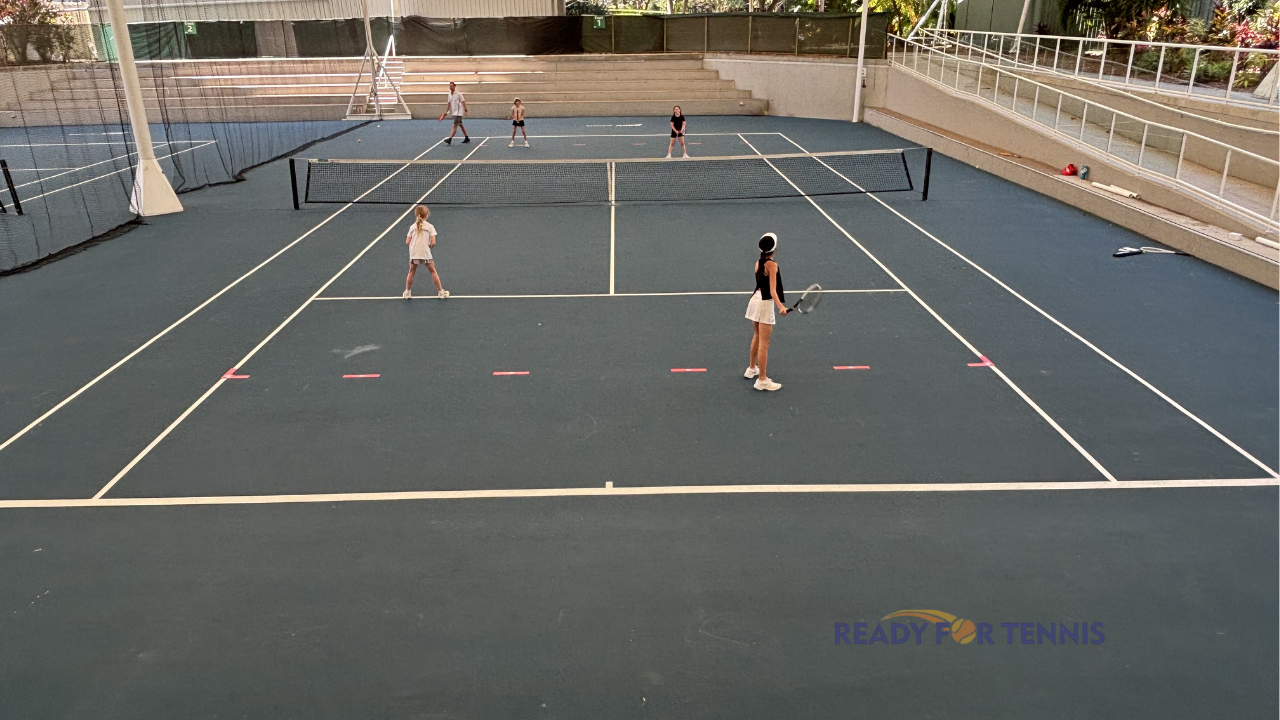
What Does an Orange Ball Court Look Like?
At the Orange Ball stage, the game is scaled to match the player.
Court Dimensions:
- Length: 18.29m
- Width:
- 6.4m (singles)
- 8.23m (doubles)
Net Height:
- Lowered to approximately 80cm
Ball Type:
- Orange Ball = 50% compression of a standard yellow ball
This means:
- Slower through the air
- Lower bounce
- Easier to control
Why the Orange Ball Is So Important
The biggest benefit of the orange ball is this:
It creates the correct contact point.
Instead of kids:
- Reaching above their shoulders
- Or hitting the ball too low
They’re able to:
- Strike the ball in their ideal hitting zone
- Develop clean technique
- Build confidence through success
This is critical.
Because when kids hit the ball at the right height, they can:
✔ Swing properly
✔ Generate spin
✔ Control direction
✔ Start understanding tactics
And most importantly:
They enjoy it more.

What Age (and Height) Is Orange Ball For?
Typically:
- Ages: 8–10 years old (this can vary slightly based on skill level)
- Average height around 133–139cm
At this stage, players are:
- Stronger
- More coordinated
- Able to process simple tactics
- Beginning to compete
The key is not just age, it’s readiness.
A player should move into Orange Ball when they can:
- Rally consistently
- Control basic direction
- Move with balance
- Understand simple scoring and positioning
The Transition: Red Ball to Orange Ball
This is one of the most important (and sometimes challenging) transitions in junior tennis.
- The court gets bigger.
- The ball moves faster.
- The game becomes more dynamic.
Here are some of the key challenges players face:
1. More Court to Cover
The wider and longer court means:
- More movement required
- Better footwork needed
- Less time to recover
2. Timing Becomes More Important
With a faster ball:
- Late contact gets exposed
- Preparation needs to improve
- Players must read the ball earlier
3. Contact Point Changes
Players must now:
- Hit more in front
- Adjust spacing more accurately
- Control height and spin
4. Decision-Making Increases
It’s no longer just “hit it back.”
Players start learning:
- Direction (crosscourt vs down the line)
- Depth
- Basic tactics
5. Emotional Adjustment
This is a big one.
Players often:
- Make more mistakes initially
- Feel less consistent
- Need time to adapt
This is completely normal.
In fact, research shows that performance often dips temporarily during transitions, especially if the move happens too early
What Are We Trying to Achieve in Orange Ball?
At Ready for Tennis, Orange Ball is where we start building:
1. Cadence of the Game
We want players to:
- Rally consistently
- Maintain rhythm
- Hit multiple balls in a row
Why?
Because tennis isn’t about one shot.
It’s about patterns.
Research from the ITF shows that with adapted equipment, players experience:
- Longer rallies
- More strokes per point
That’s exactly what we want.
2. Movement Like a Tennis Player
We start developing:
- Split step
- Recovery steps
- Lateral movement
- Balance through shots
Players begin to move like mini versions of full-court players.
3. Technical Foundations
This includes:
- Consistent contact point
- Controlled swing path
- Introduction to topspin
- Stable grips
These are the foundations that carry into green and full court.
4. Tactical Awareness
Players start to understand:
- Where to hit the ball
- How to move an opponent
- Basic patterns (crosscourt rallying)
And importantly:
They start thinking, not just reacting.
5. Independence in Play
One of the biggest advantages of Orange Ball:
Players can rally without constant coach feeding.
This builds:
- Confidence
- Decision-making
- Ownership of learning

Preparing for the Next Stage: Orange to Green
The move from Orange Ball to Green Ball is a big jump.
- The court becomes full size.
- The ball gets faster.
- The game becomes more physical and tactical.
Here’s what we’re preparing for during the Orange stage:
1. Handling Increased Court Size
On the green court:
- The court is longer and wider
- Players must cover more distance
- Movement becomes more demanding
So in Orange Ball, we build:
- Efficient movement patterns
- Recovery habits
- Court awareness
2. Dealing With Faster Balls
Green ball:
- Travels faster
- Bounces higher
- Requires quicker reactions
So in Orange Ball, we prepare:
- Early preparation
- Better timing
- Faster decision-making
3. Playing From Deeper Positions
On a full court:
- Players often get pushed behind the baseline
- They need to manage depth and positioning
So we teach in Orange:
- Depth control
- Recovery positioning
- Court spacing
4. Expanding Tactical Awareness
Green stage introduces:
- More complex patterns
- Attacking vs defending decisions
- Use of angles and space
So in Orange, we build:
- Basic tactical understanding
- Directional control
- Consistency under pressure
5. Managing the Transition Mentally
One of the biggest insights from coaching and research:
When players move to green:
- Their performance can drop initially
- The game feels harder
- Confidence can dip
This is normal.
The goal of Orange Ball is to prepare players so that:
✔ The transition is smoother
✔ The adjustment period is shorter
✔ Confidence stays intact
The Big Picture
Orange Ball is not a stepping stone to rush through.
It’s where:
Technique becomes stable
Movement becomes purposeful
Thinking becomes part of the game
When done properly, players don’t just “get through” Orange Ball.
They grow through it.
Final Thought for Parents
If your child is in Orange Ball right now:
- They’re not “behind.”
- They’re right where they need to be.
Because strong foundations at this stage lead to:
- Better long-term performance
- Fewer technical issues later
- More enjoyment of the game
And ultimately, a player who can actually play tennis - not just hit balls.